SGLang v0.3
❖ We’re excited to announce the release of SGLang v0.3, which brings significant performance enhancements and expanded support for novel model architectures. Here are the key updates: Up to 7x higher throughput for DeepSeek Multi-head Latent Attention (MLA). Up to 1.5x lower latency with torch.compile on small batch sizes. Support for interleaved text and multi-image/video in LLaVA-OneVision. Support for interleaved window attention and 2x longer context length in Gemma-2.

Qwen2-VL
❖ Qwen2-VL is the latest version of the vision language models in the Qwen model families. SoTA understanding of images of various resolution & ratio: Qwen2-VL achieves state-of-the-art performance on visual understanding benchmarks, including MathVista, DocVQA, RealWorldQA, MTVQA, etc. Understanding videos of 20min+: with the online streaming capabilities, Qwen2-VL can understand videos over 20 minutes for high-quality video-based question answering, dialog, content creation, etc.
Text2SQL Leaderboard
❖ Text-to-SQL (or Text2SQL), as the name implies, is to convert text into SQL. A more academic definition is to convert natural language problems in the database field into structured query languages that can be executed in relational databases. Therefore, Text-to-SQL can also be abbreviated as NL2SQL. Input: natural language questions, such as Query the relevant information of the table t_user, and the results are sorted in descending order by id. Output: SQL, such as SELECT * FROM t_user ORDER BY id DESC.
SGLang v0.2
❖ Through our operational experiences and in-depth research, we’ve continuously enhanced the underlying serving systems for Chatbot Arena, spanning from the high-level multi-model serving framework, FastChat, to the efficient serving engine for LLMs and VLMs, SGLang Runtime (SRT). While existing options like TensorRT-LLM, vLLM, and Hugging Face TGI have their merits, we found them sometimes hard to use, difficult to customize, or lacking in performance. This motivated us to create a serving engine that is not only user-friendly and easily modifiable but also delivers top-tier performance.

FlashAttention-3
❖ Attention, as a core layer of the ubiquitous Transformer architecture, is a bottleneck for large language models and long-context applications. FlashAttention (and FlashAttention-2) pioneered an approach to speed up attention on GPUs by minimizing memory reads/writes, and is now used by most libraries to accelerate Transformer training and inference. This has contributed to a massive increase in LLM context length in the last two years, from 2-4K (GPT-3, OPT) to 128K (GPT-4), or even 1M (Llama 3).
Awesome LLM
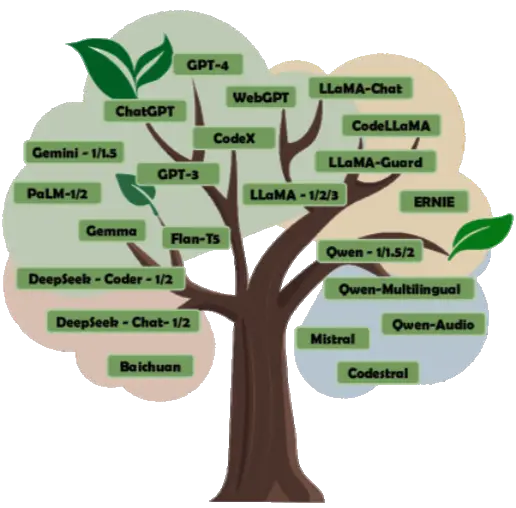
❖ Large Language Models (LLMs) have taken the Whole World by storm. Here is a curated list of papers about large language models, especially relating to ChatGPT. It also contains frameworks for LLM training, tools to deploy LLM, courses and tutorials about LLM and all publicly available LLM checkpoints and APIs.

DeepSeek-Coder-V2
❖ We present DeepSeek-Coder-V2, an open-source Mixture-of-Experts (MoE) code language model that achieves performance comparable to GPT4-Turbo in code-specific tasks. It is further pre-trained from an intermediate checkpoint of DeepSeek-V2 with additional 6 trillion tokens. Through this continued pre-training, DeepSeek-Coder-V2 substantially enhances the coding and mathematical reasoning capabilities of DeepSeek-V2, while maintaining comparable performance in general language tasks.

Accelerating Self-Attentions for LLM Serving with FlashInfer
❖ The efficacy of operators within Transformers – namely GEMM, Self-Attention, GEMV, and elementwise computations are critical to the overall performance of LLM (Large Language Models) serving. While optimization efforts have extensively targeted GEMM and GEMV, there is a lack of performance studies focused on Self-Attention in the context of LLM serving. In this blog post, we break Self-Attention down into three stages: prefill, decode, and append; analyze the performance bottleneck of Self-Attention on both single-request and batching scenarios in these three stages; and propose a solution to tackle these challenges.